Type 1+2 Surge Protection Device

Type 1+2 AC Surge Protection Device Solutions for Service Entrance & Main LV Distribution

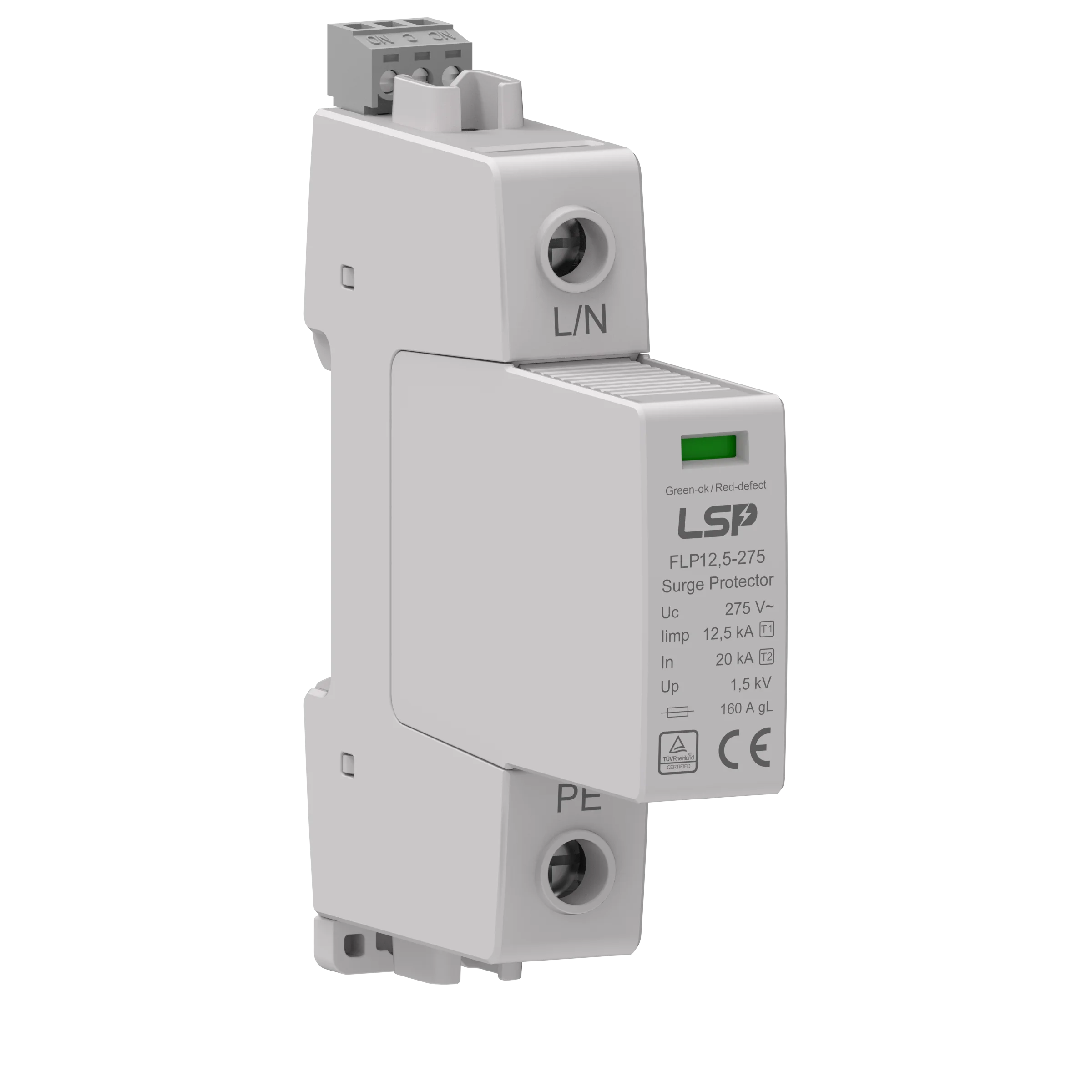
LSP provides Type 1+2 AC surge protection devices designed for installation at the transition between LPZ 0A/0B and LPZ 1 in low-voltage power distribution systems, serving as combined surge protection at the service entrance.

These Type 1+2 SPDs are suitable for industrial power distribution systems, commercial buildings, critical infrastructure, and applications with high system continuity requirements, supporting system-level surge protection solutions at the service entrance.

The FLP12.5 / FLP7 combined SPD series is designed in accordance with IEC 61643-11 and features a pluggable, modular construction. A single device provides coordinated protection against direct lightning impulse currents (10/350 µs) as well as surge currents caused by lightning induction and switching operations (8/20 µs).

The products support TT, TN-S, and TN-C-S power supply systems. The design addresses long-term thermal stability, controlled surge energy dissipation, and structural integrity under high-energy impulse conditions, supporting continuous operation of Type 1+2 SPDs under specified conditions.

Play Video about AC-and-DC-Surge-Protection-Device-SPD-Manufacturer

Type 1+2 / Class I+II

Combined lightning current protection

10/350 μs & 8/20 μs

Compatible with Type 1 and Type 2 surge waveforms

TN / TT / IT systems

Suitable for all standard earthing systems

IEC / EN 61643-11

Standards compliance

Type 1+2 SPD Surge Protection Devices Overview

Type 1+2 surge protection devices (SPDs) integrate the protection functions of both Type 1 and Type 2, providing coordinated defense against direct lightning impulse currents and switching surges at service entrances and main distribution boards.

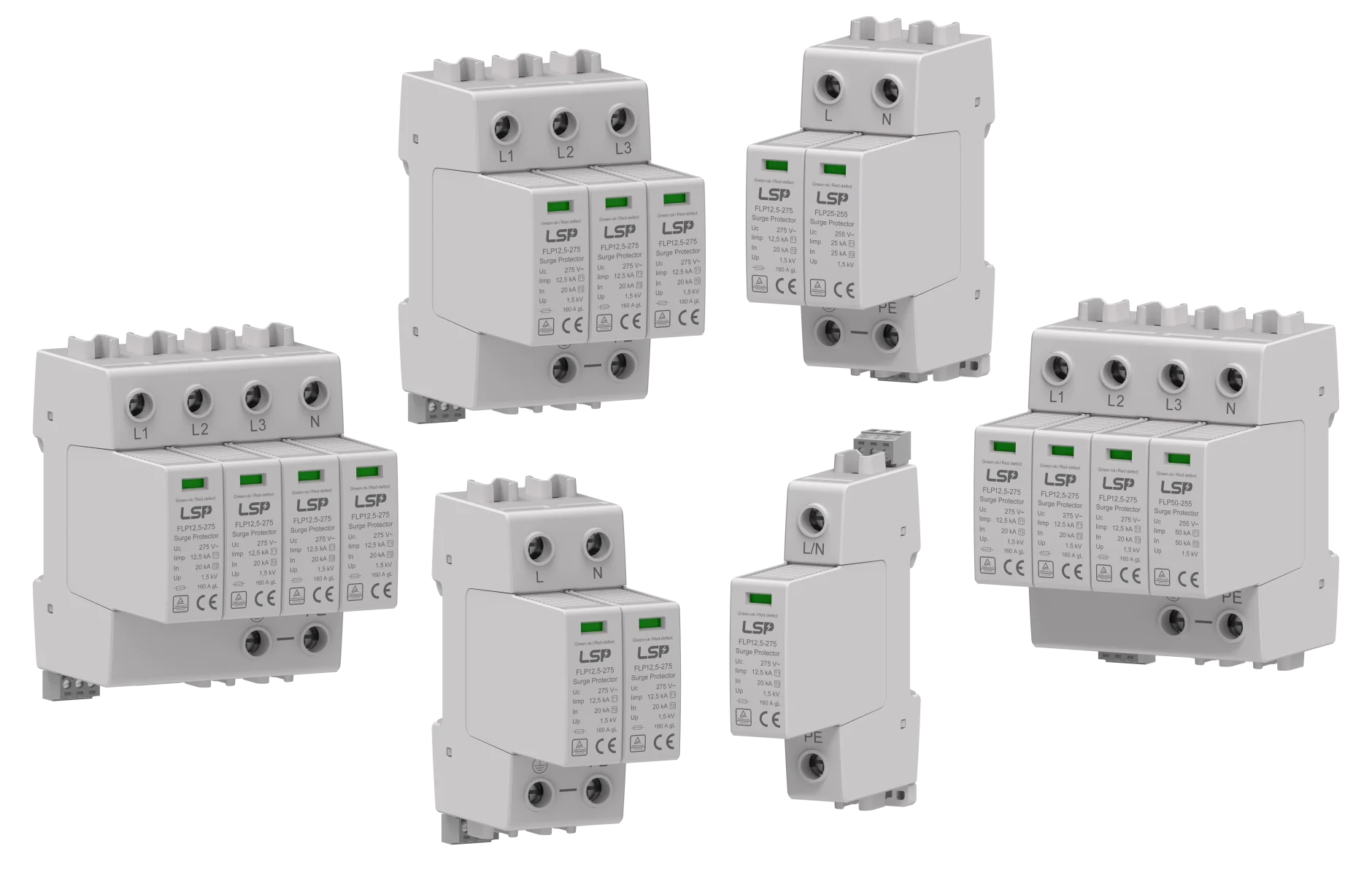
The Type 1+2 SPDs are available with Iimp (10/350 µs) ratings of 12.5 kA and 7 kA, In 20 kA, and Imax 50 kA, allowing selection based on system lightning exposure and design requirements, suitable for residential, commercial, and industrial AC systems.

All Type 1+2 Surge Protection Device
FLP12,5-275 Series
FLP7-275 Series
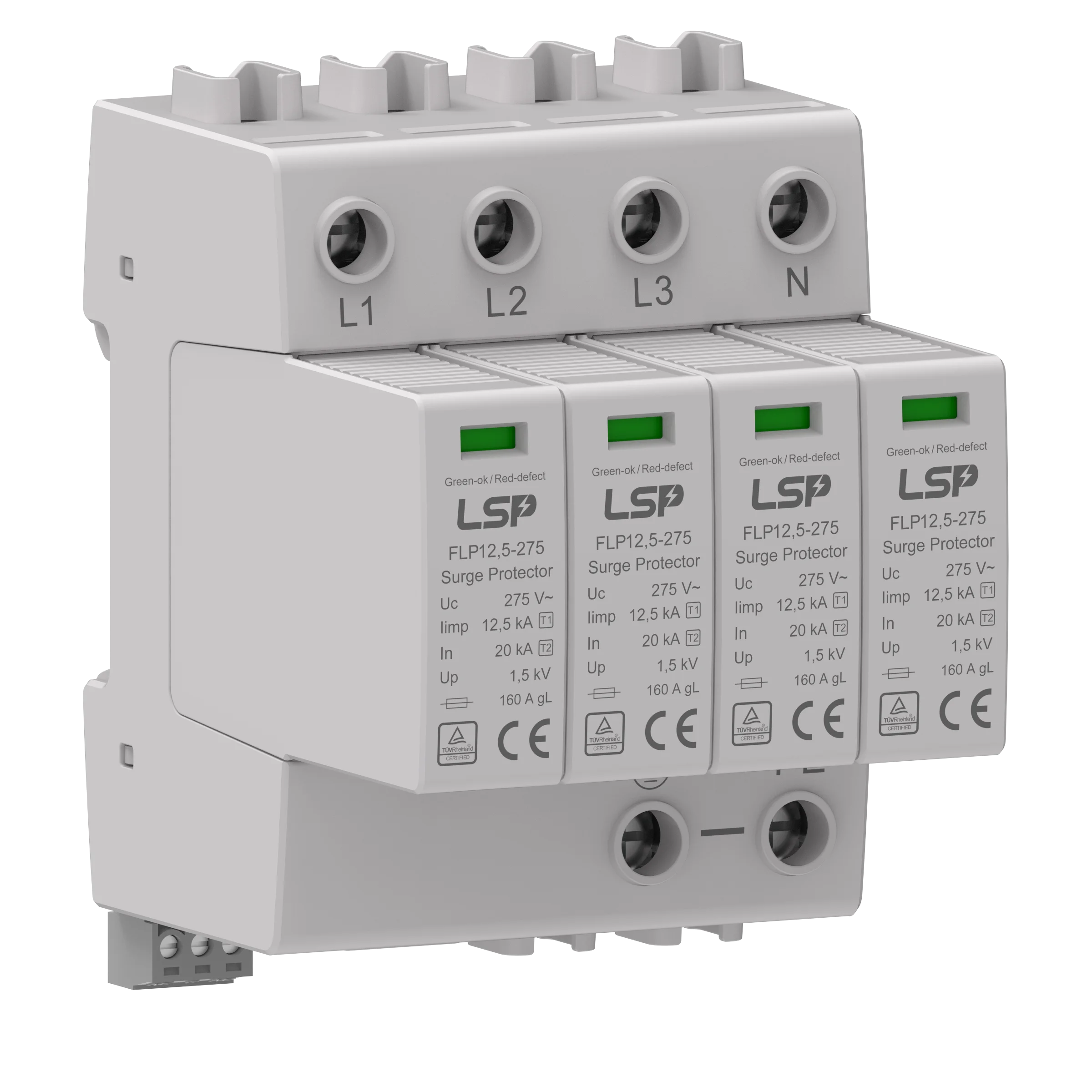
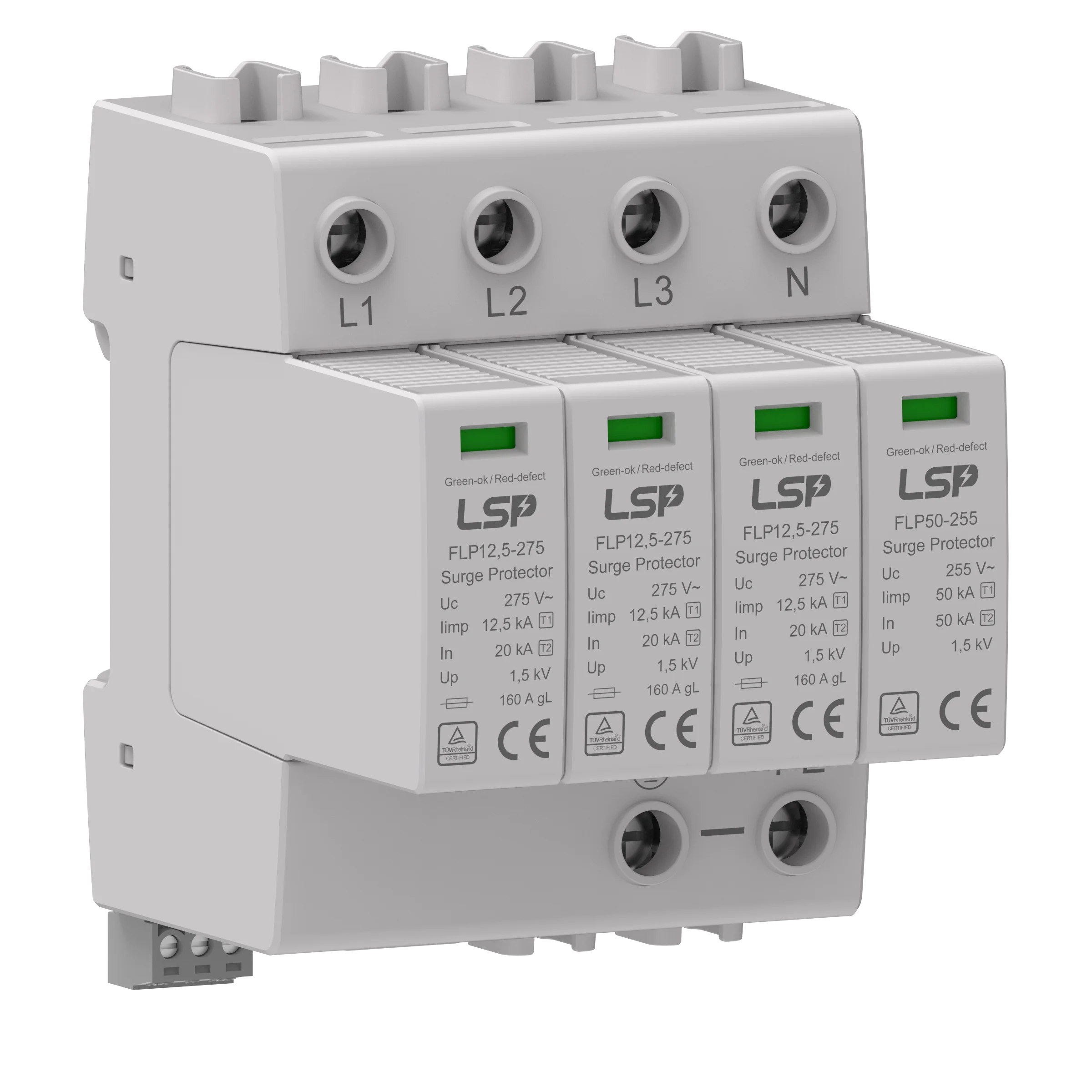
Type 1+2 AC Surge Protective Device SPD FLP12,5-275-3S+1
View More Details
Type 1+2 AC Surge Protective Device SPD FLP12,5-275-4S
View More Details
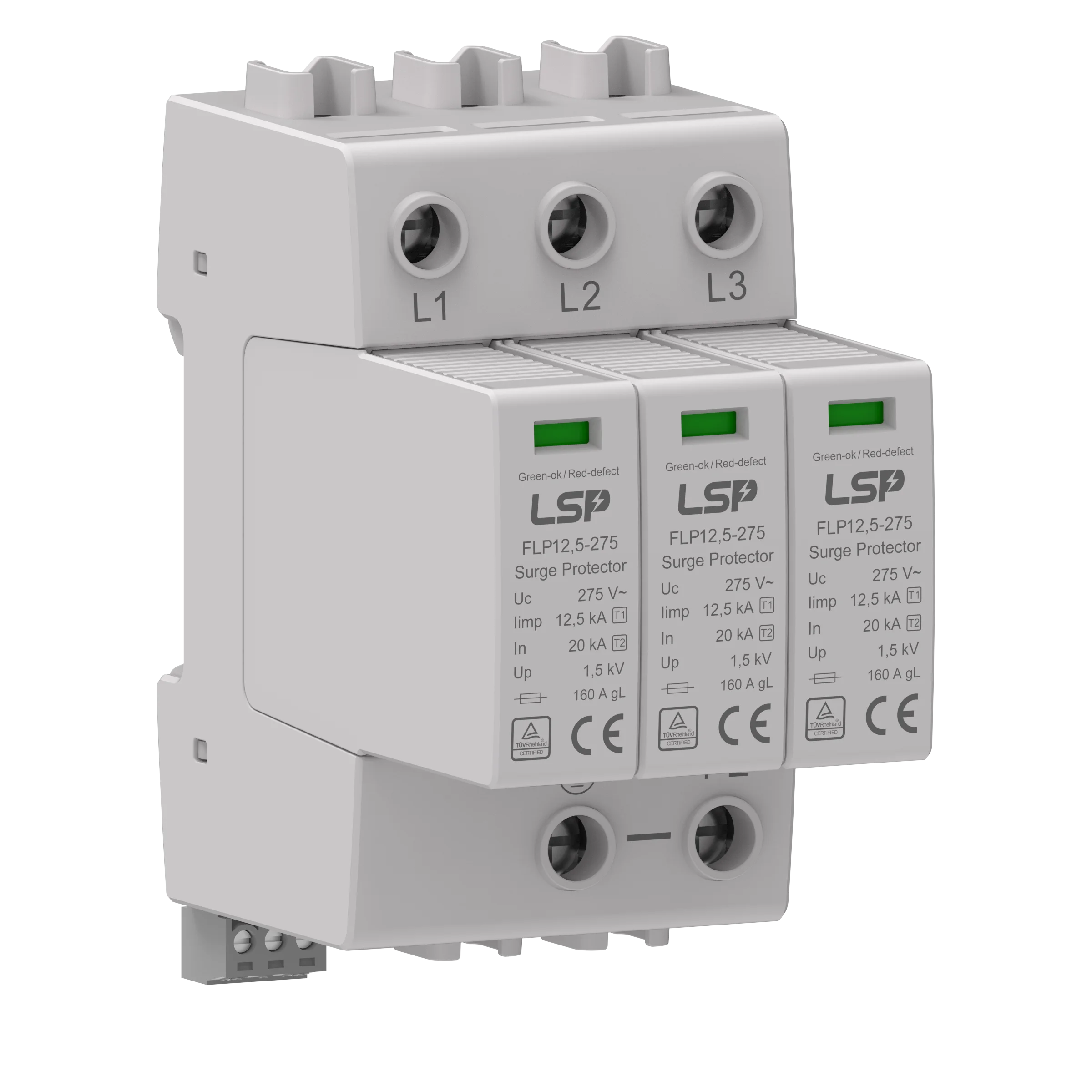
Type 1+2 AC Surge Protective Device SPD FLP12,5-275-3S
View More Details
Type 1+2 AC Surge Protective Device SPD FLP7-275-3S+1
View More Details
Type 1+2 AC Surge Protective Device SPD FLP7-275-4S
View More Details
Type 1+2 AC Surge Protective Device SPD FLP12,5-275-2S
View More Details
1 2

Components of Type 1+2 Surge Protection Devices

The primary functional components of Type 1+2 Surge Protection Devices (SPDs) include the MOV voltage-limiting element, GDT high-energy discharge path, reinforced conductors and structural support, and SPD status indication & remote monitoring module.

Each component is engineered to manage high-energy lightning impulses, induced surges, and switching transients, ensuring stable current paths, reliable energy dissipation, and continuous operational monitoring throughout the device’s service life.

MOV (Metal Oxide Varistor)

The MOV is a voltage-dependent component in a Type 1+2 SPD. When the system voltage exceeds its threshold, it conducts rapidly to limit overvoltage and dissipate energy from switching and induced surges, serving as the primary voltage-limiting element.

Reinforced Conductors & Mechanical Support

Reinforced conductive components and structural supports maintain reliable current paths and mechanical integrity in Type 1+2 SPDs during high-energy surge events. This minimizes contact resistance and thermal stress under impulse currents.

GDT (Gas Discharge Tube)

In TT and TN-S power systems, the N-PE module equipped with a GDT prevents continuous power-frequency follow currents after SPD operation. The interrupting capability of such follow currents is rated according to the follow current interrupt rating (Ifi).

SPD Status Indication & Remote Monitoring

The Type 1+2 SPD status indication and remote monitoring module provides visual and remote signaling to report operational conditions. It enables system monitoring and maintenance of the surge protection device throughout its service life.

Type 1+2 SPD Surge Protection Devices: Technical Principles and Performance Overview

Type 1+2 surge protection devices (SPDs) are composite protection units compliant with IEC/EN 61643‑11. By integrating the features of both Type 1 and Type 2, they provide coordinated protection against lightning impulse currents at the service entrance and switching surges downstream.

Type 1+2 SPDs undergo standardized performance testing and modular assembly, effectively controlling the voltage protection level (Up) and serving as part of a system-level surge protection strategy.

What Is a Type 1+2 Surge Protection Device?

Type 1+2 Surge Protection Devices (SPDs) are composite protection modules that integrate high-energy lightning current absorbers (Type 1) with transient overvoltage suppressors (Type 2) within a single unit, providing continuous protection from the service entrance to downstream equipment.

The Type 1+2 SPDs absorb lightning impulse energy and suppress transient overvoltages caused by switching or induced events, providing coordinated protection for downstream equipment and supporting system-level surge management strategies.

Surge Handling – 10/350 µs and 8/20 µs Currents

  • Type 1+2 SPDs can withstand simulated lightning impulse currents of 10/350 µs and handle switching or induced surges of 8/20 µs.
  • If the upstream protection does not coordinate these energy levels, downstream equipment may experience elevated residual voltage.

System Positioning – Between Type 1 and Type 2

  • Type 1+2 SPDs are installed at the service entrance or near the main distribution board to reduce residual voltage affecting sensitive equipment.
  • They provide voltage protection (Up) not achievable by a single Class I device and are suitable for TN-S, TN-C, and TT systems, especially where space is limited, and high protection levels are required.

Protection Concept & Coordination of Type 1+2 AC SPDs

Type 1+2 AC surge protection devices provide coordinated Type 1 and Type 2 protection:

  • Type 1 / Class I: 10/350 µs, for first-stage surge absorption (primary surge dissipation);
  • Type 2 / Class II: 8/20 µs, for attenuation of switching transient overvoltages.
    This combination allows surge energy dissipation and downstream voltage limitation in a single module, protecting sensitive downstream equipment.

How Does Type 1+2 SPDs Work?

Type 1+2 surge protection devices handle lightning impulses, induced surges, and switching transient overvoltages within a single module. Internal coordination controls surge paths and residual voltage, suitable for service entrance and main distribution systems.
Upon a surge, the MOV (metal-oxide varistor) responds first, diverting transient energy. The GDT (gas discharge tube) then provides a low-impedance path for the remaining surge current, ensuring safe energy dissipation.
Through the coordinated action of MOV and GDT, Type 1+2 SPDs provide coordinated dissipation of induced surges and switching transient overvoltages, and support system-level protection with downstream SPDs.
Play Video about Type 1+2 Surge Protector Device AC SPD Internal Structure and Working Principle

Type 1+2 SPD Assembly & Internal Inspection

The assembly process of Type 1+2 SPDs follows a controlled engineering manufacturing procedure, including the following key steps:

1. Selection and pre-matching of core components

  • MOVs and GDTs are selected according to design specifications and tested for electrical consistency.

2. Component soldering and interconnection

  • MOVs and GDTs are precisely soldered and interconnected to ensure stable current paths and controlled contact resistance.

3. Integration of the surge indication and the remote monitoring module

  • Visual status indicators and remote signal interfaces are installed to provide local indication and system-level monitoring of SPD status.

4. Structural reinforcement and insulation assembly

  • Reinforced metal components and reliable insulation materials are used to enhance mechanical strength and grounding continuity.

5. Final consistency and functional testing

  • Finished units undergo mechanical inspection, voltage characteristic testing, and signal verification to ensure suitability for long-term field operation.
Play Video about Class B+C Type 1+2 AC Surge Protective Device SPD FLP7-2751S

Key Technical Parameters Explained for Type 1+2 SPD

Lightning Impulse & Discharge Current - Iimp, In, Imax

Handles lightning impulse current (Iimp) and rated/maximum discharge currents (In, Imax) to protect the service entrance and downstream circuits from high-energy surges.

Voltage Protection Level - Up & Equipment Withstand Voltage

Controls residual voltage Up within equipment limits, preventing overvoltage damage to sensitive devices.
  • MOVs provide rapid and stable triggering; GDTs offer high current-carrying capacity and prevent follow-on current.

Maximum Continuous Operating Voltage - Uc & System Matching

SPD withstands maximum continuous voltage Uc, ensuring coordination with the distribution system and downstream SPDs.

ParameterModelSignificance
FLP12.5-275 FLP7-275
Iimp (10/350 µs)12.5 kA7 kACapacity to handle lightning impulse energy
In (8/20 µs)20 kA20 kANominal SPD discharge capability
Imax (8/20 µs)50 kA50 kAMaximum energy SPD can safely discharge
Up1.5 kV1.5 kVLimits residual voltage to protect loads
Uc275 V275 VEnsures SPD matches system voltage

Type 1+2 Surge Protection Devices: Protection Features and System Benefits

Type 1+2 surge protection devices are installed at the boundary between LPZ 0A/0B and LPZ 1. By integrating lightning impulse current dissipation and voltage limitation functions, they simplify multi-stage surge protection and support coordinated protection with downstream LPZ 2.
High-Durability MOV Material Selection
Type 1+2 surge protection devices use high-performance metal oxide varistors (MOVs) designed to withstand lightning impulse currents (10/350 µs) and switching surge currents (8/20 µs), maintaining stable electrical characteristics and consistent energy dissipation over long-term operation.
Integrated Thermal Disconnection Mechanism
Type 1+2 SPD incorporates a thermal disconnection mechanism to safely isolate the module under abnormal thermal conditions, supporting controlled disconnection during high-energy surge events.
Combined Type 1 and Type 2 Protection
Type 1+2 surge protection devices integrate Type 1 (10/350 µs) and Type 2 (8/20 µs) protection in a single module, providing coordinated protection against direct lightning currents and switching surges across the distribution system.
Flame-Retardant Enclosure Design
The enclosure of the Type 1+2 SPD is made from reinforced flame-retardant materials, such as PA6+GF30 %, suitable for operation under high-energy surges and thermal stress while maintaining long-term thermal and mechanical stability.
Reinforced Metal Conductive Components
Key conductive components of the Type 1+2 surge protection device are mechanically reinforced, for example with terminals approximately 0.8 mm thick and 8 mm wide, ensuring stable current paths and structural integrity under high-energy impulse currents.
Comprehensive Performance Verification
Type 1+2 SPD undergoes standardized testing, including 10/350 µs lightning impulses, 8/20 µs surge currents, thermal stability, salt spray exposure, and current impulse cycling, confirming electrical, thermal, and environmental performance.

Type 1+2 AC surge protection devices Application Scenarios

Type 1+2 AC surge protection devices (SPDs) are installed at service entrances and main distribution boards to handle lightning impulse and switching surges, supporting system-level protection and voltage limitation for downstream circuits.

Type 1+2 SPD Laboratory Testing & Performance Verification

Performance verification confirms that Type 1+2 SPDs withstand lightning impulses and switching surges while maintaining system-level protection at the LPZ 0/1 boundary. Tests cover full functionality of Type 1 and 2 surge protection devices at service entrances and main distribution boards.

Certifications of LSP Type 1+2 Surge Protection Devices

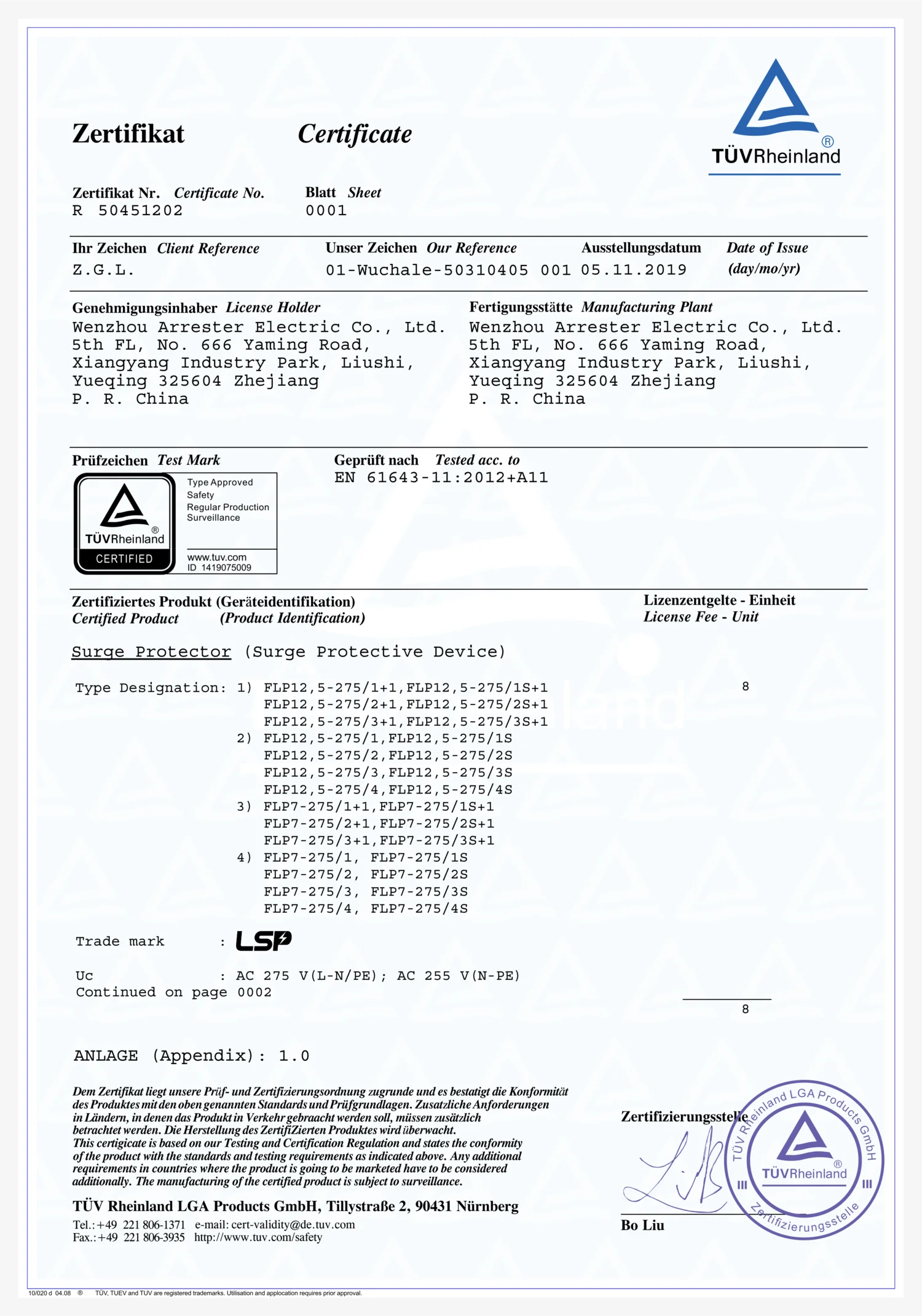
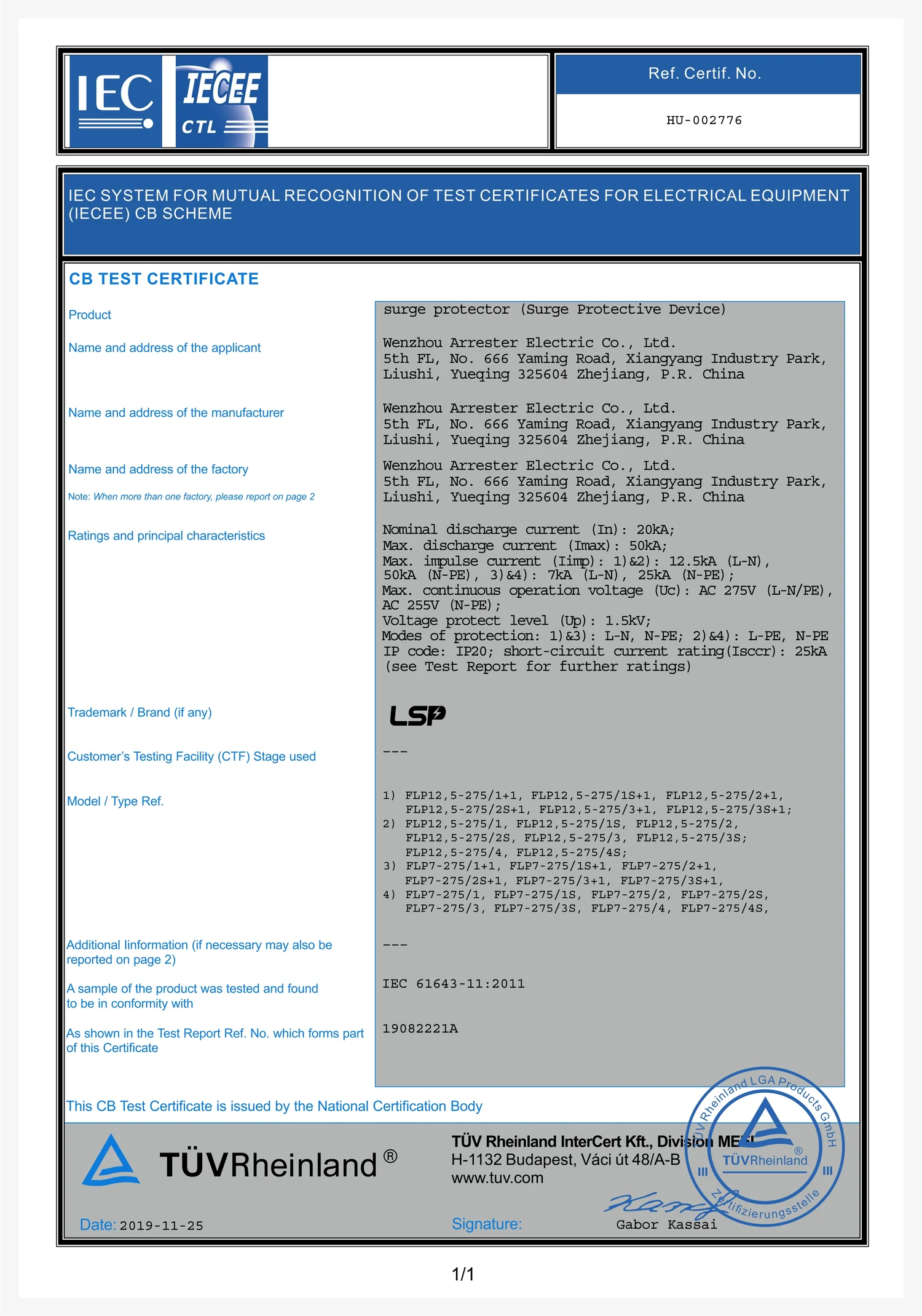
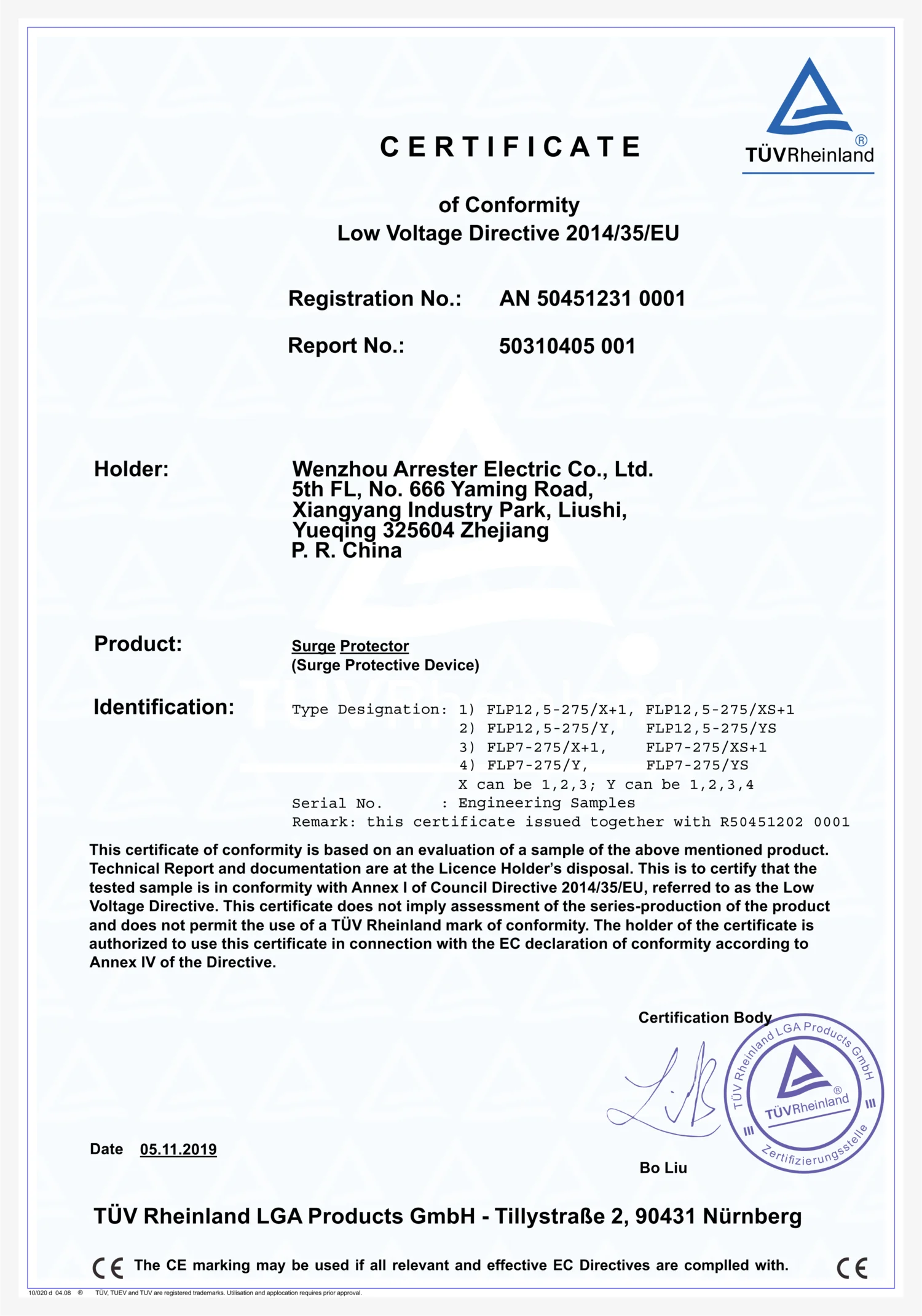
The design and testing of Type 1+2 surge protection devices follow the IEC/EN 61643‑11 standard, which defines performance requirements and test methods for low-voltage surge protective devices, including composite testing for Type 1 (high-energy lightning impulses) and Type 2 (transient surges) protection. The product is certified by the independent third-party body TUV, confirming its performance and safety under specified surge conditions.

Type 1+2 Surge Protection Devices Manufacturing Process & Production Capability

The production of Type 1+2 surge protection devices is conducted under strict international quality systems and standardized engineering procedures, including critical component selection, precision forming, automated assembly, and multi-stage testing. The manufacturing facilities are ISO9001 certified and verified through independent third-party testing, ensuring consistent performance and reliability across batches under high-energy lightning and switching surge conditions.

Type 1+2 Surge Protection Device Installation Guidelines

Type 1+2 surge protection devices (SPDs) are typically installed at the service entrance or near the main distribution panel in low-voltage systems. Wiring must follow IEC/EN installation standards, with dedicated upstream circuit breakers or fuses.
AC Type 1+2 Surge Protector Device SPD Wiring Diagram, Connection and Installation
Play Video about AC Type 1+2 Surge Protector Device SPD Wiring Diagram, Connection and Installation

Wiring Principles & Connection Integrity

  • Type 1+2 surge protection devices (SPDs) are typically connected in parallel ahead of the main circuit breaker in the main distribution panel.
  • L, N, and PE are connected to the line, neutral, and protective earth.
  • Used with dedicated circuit breakers or fuses, they respond quickly to system surges.
  • Wiring should be kept short and secure (≤ 0.5 m) to minimize inductance and contact resistance, reducing induced voltages on the SPD.

Remote Signaling Terminals

  • Type 1+2 SPDs with remote signaling terminals provide operational status feedback.
  • Dry contacts output SPD status and fault signals to the control panel.
  • Connect the signal wires to the corresponding monitoring terminals on the control panel to enable remote monitoring.
  • Alert signals are generated in case of faults or abnormal conditions, assisting maintenance personnel in quickly identifying issues and improving system maintenance efficiency.

Project Feedback on Type 1+2 Surge Protection Devices

Feedback is provided by site engineers, operations, and project leads with experience using Type 1+2 surge protection devices in operational environments. Observations cover device behavior under system operation, surge response, continuity, and installation compatibility.

FAQ: Type 1+2 Surge Protection Devices

Guess You Want to Know
Still Have Questions?

What is Type 1+2 surge protection device and how does it work?

A Type 1+2 surge protection device (SPD) integrates the functions of a Type 1 SPD, which handles direct lightning currents at service entrances, and a Type 2 SPD, which manages switching surges and residual lightning energy within distribution boards. It provides comprehensive surge protection for residential, commercial, and industrial AC systems.

Can a single Type 1+2 SPD protect against both lightning and switching surges?

Yes. The Type 1+2 surge protection device (SPD) integrates the functions of both Type 1 and Type 2 surge protectors, withstanding high-energy lightning impulses (10/350 µs) as well as lower-energy switching transients (8/20 µs). A single unit provides multi-functional surge protection while saving installation space.

When should I choose a Type 1+2 surge protection device instead of a Type 2 SPD?

A Type 1+2 surge protection device is recommended for installations exposed to lightning risk, outdoor overhead lines, or service entrances. For indoor locations with low lightning exposure, a Type 2 SPD may suffice.

Are Type 1+2 AC surge protection devices suitable for industrial power systems?

Yes. Type 1+2 AC surge protection devices are widely applied in industrial and commercial power systems to protect inverters, control cabinets, servers, and monitoring equipment, ensuring uninterrupted operation.

How do I coordinate a Type 1+2 SPD with downstream devices?

A Type 1+2 SPD should be installed at service entrances or main boards, with downstream Type 2 SPDs in sub-distribution panels. Coordination ensures system-level protection, diverting surges while maintaining safe voltage levels for connected equipment.

How do I check if a Type 1+2 SPD is malfunctioning?

Most Type 1+2 SPDs feature a visual status window or remote signaling terminals. Check the indicator to verify normal operation or if module replacement is needed.

What is the response time and discharge capacity of a Type 1+2 surge protection device?

A Type 1+2 surge protection device uses high-energy MOVs, achieving fast response to transients. Ratings include lightning impulse currents (Iimp, 10/350 µs) up to 12.5 kA and nominal discharge currents (In, 8/20 µs) up to 20 kA, ensuring protection of critical equipment.

What installation precautions are required for a Type 1+2 AC SPD?

Before installing Type 1+2 AC SPDs, power must be isolated. Key precautions:

  • Keep wiring short and straight (≤ 0.5 m)
  • Avoid coiled or twisted cables
  • Use smooth bends, avoid sharp 90° turns
  • Ensure correct lead length to maximize surge protection efficiency

Get A Quote Now

Empower Sales and Maximize Market Potential with LSP