Power outages can disrupt critical operations, damage sensitive equipment, and create safety risks in residential, commercial, and industrial facilities. An automatic transfer switch (ATS) plays a vital role in backup power systems by automatically transferring electrical loads from the primary power source to a standby source when a failure occurs. Understanding what an automatic transfer switch does, how it works, and where it is used can help system designers and facility managers improve power reliability, minimize downtime, and ensure continuous operation during unexpected outages.
What is an Automatic Transfer Switch?
An automatic transfer switch (ATS) is an electrical device that monitors the incoming utility power and automatically switches the power load of the facility to the backup power source in the event of a power outage.
In most commercial and industrial settings, the backup power source is typically a backup generator. When the voltage or frequency of the mains power exceeds the acceptable range, the automatic transfer switch (ATS) will send a start signal to the generator. After a stable output is achieved, the load will be switched to the backup power source. When the mains power is restored, the ATS will switch the load back to the mains power and shut down the generator.
The entire process does not require any intervention from the operator. It is precisely because of this automation that many regulated environments must be equipped with automatic transfer switches (ATS), and it is recommended that almost all critical mission facilities be equipped with ATS as well.
What Does an Automatic Transfer Switch Do During a Power Failure?
Monitoring the Main Power Supply Continuously
An automatic transfer switch (ATS) continuously monitors the main power supply to ensure stable voltage, frequency, and phase conditions. The moment it detects a power interruption, voltage drop, or abnormal electrical condition, the ATS control system begins evaluating the source status. Continuous monitoring enables rapid fault detection, allowing the switch to respond immediately and maintain power continuity. This function is essential for protecting critical equipment and reducing downtime in commercial, industrial, and backup power applications.
Detecting Voltage Loss and Power Abnormalities
During a power failure, an automatic transfer switch (ATS) detects voltage loss and other electrical abnormalities such as under-voltage, over-voltage, phase imbalance, or frequency deviation. Once the main supply falls outside acceptable parameters or is completely lost, the ATS control system immediately recognizes the fault condition. It then sends a signal to initiate the transfer process, ensuring a backup power source can be engaged quickly. This rapid detection helps prevent equipment damage and maintains power stability for critical loads.
Automatically Switching to the Backup Source
During a power failure, an automatic transfer switch (ATS) automatically switches the electrical load from the main utility supply to a backup power source, such as a generator. Once a fault is confirmed, the ATS disconnects the failed source to prevent backfeed and safely connects the standby supply. This switching process happens within seconds, ensuring continuous power to critical systems without manual intervention. It helps maintain operational stability in facilities where even short outages are unacceptable.
Restoring the Load to the Main Supply After Recovery
After the main power supply is restored, an automatic transfer switch (ATS) continuously verifies that voltage, frequency, and stability have returned to normal levels. Once the utility source is confirmed to be stable for a preset period, the ATS initiates a retransfer process. It safely switches the load back from the backup power source to the main supply, often with a brief overlap or open transition depending on the system design. After retransfer, the backup source is cooled down or shut off, returning the system to standby mode for the next outage.
Ensuring Uninterrupted Operation of Critical Equipment
During a power failure, an automatic transfer switch (ATS) ensures uninterrupted operation of critical equipment by rapidly shifting the electrical load to a reliable backup power source. This seamless transition minimizes downtime for essential systems such as medical devices, data servers, security systems, and industrial control equipment. By continuously monitoring power conditions and executing automatic switching within seconds, the ATS maintains stable electricity flow and prevents operational disruptions. This reliability is crucial for facilities where even brief outages can cause safety risks or data loss.
How an Automatic Transfer Switch Works in Backup Power Systems
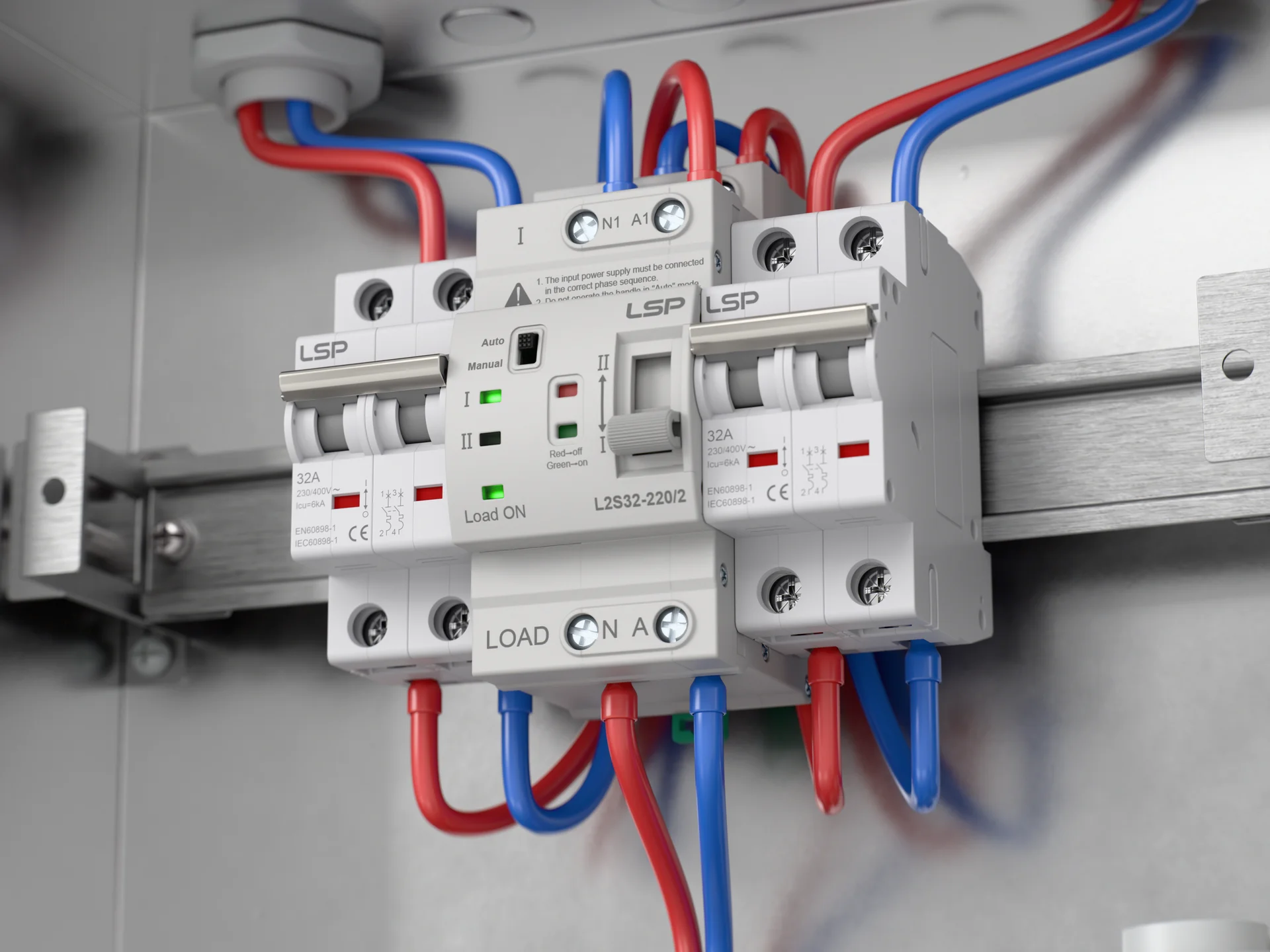
When the power grid goes down, every second counts. The automatic transfer switch is the silent guardian of your power system – continuously monitoring voltage fluctuations, frequency abnormalities, or complete power outages of the main power source. Therefore, understanding the working principle of the ATS is of utmost importance.
Main Power and Standby Power Configuration:
- The automatic transfer switch (ATS) is connected to both the main utility power source and a standby backup source, typically a generator.
- The main power supply normally carries the electrical load during stable operating conditions.
- The standby power source remains in a ready state, activated only when the main supply fails or becomes unstable.
- The ATS continuously monitors both sources to ensure proper voltage, frequency, and phase conditions.
- It establishes a priority system, giving preference to the main power while keeping the backup system on standby.
- This configuration ensures a seamless and reliable transition between power sources during outages or recovery.
Voltage Sensing and Failure Recognition:
- The automatic transfer switch (ATS) continuously monitors the voltage levels of the main power source in real time.
- It detects abnormal conditions such as power loss, under-voltage, over-voltage, or phase failure.
- Built-in sensing circuits compare incoming electrical parameters with preset operating thresholds.
- When voltage falls outside the acceptable range, the ATS recognizes the condition as a power fault.
- To avoid unnecessary switching, the system may apply a short time delay to confirm the failure is not temporary.
- Once the fault is verified, the ATS initiates the transfer sequence to connect the load to the standby power source.
Control Logic and Transfer Decision Process:
The control logic of an automatic transfer switch (ATS) continuously analyzes voltage, frequency, phase status, and source availability to determine whether a transfer is required. When the main power source fails or operates outside preset limits, the controller verifies the fault and initiates a transfer command. It safely disconnects the load from the utility source and connects it to the standby source.
Switching Mechanism and Load Transfer Operation:
- The switching mechanism is the core component that physically transfers the electrical load between power sources.
- When a power failure is detected, the ATS disconnects the load from the main utility supply.
- After verifying the standby source is available and stable, the ATS connects the load to the backup power source.
- Mechanical or motor-driven contacts ensure reliable switching while preventing simultaneous connection of both sources.
- Interlocking systems enhance safety by eliminating the risk of backfeed or source overlap.
Automatic Re-Transfer and Recovery Sequence:
The automatic re-transfer and recovery sequence begins when the automatic transfer switch (ATS) detects that the main utility power has been restored. The ATS monitors the recovered source to confirm that voltage, frequency, and other electrical parameters remain stable for a preset time period. Once stability is verified, the ATS safely transfers the load from the backup source back to the main supply. After the load is restored to utility power, the backup generator enters a cooldown cycle and then returns to standby mode, completing the recovery process and preparing the system for future outages.
Key Components That Enable Automatic Power Transfer
Here are the key components that enable automatic power transfer
- Power Input and Output Terminals
Power input and output terminals serve as the primary connection points within an automatic transfer switch (ATS). They connect the utility power source, standby generator or alternative power source, and the electrical load. These terminals are designed to handle rated current levels safely while maintaining stable electrical connections. Proper terminal design reduces power loss, minimizes overheating risks, and ensures reliable power transfer during normal operation and emergency conditions. - Voltage Monitoring Circuitry
Voltage monitoring circuitry continuously supervises the electrical characteristics of both the main and standby power sources. It detects conditions such as power outages, undervoltage, overvoltage, phase loss, phase imbalance, and frequency deviations. By comparing real-time measurements against preset thresholds, the circuitry quickly identifies abnormal conditions and sends signals to the controller. Accurate monitoring is essential for preventing unnecessary switching and ensuring timely activation of backup power. - Controller and Transfer Logic Module
The controller acts as the intelligence center of the ATS. It receives data from voltage sensing circuits and processes information based on programmed transfer logic. When a fault is detected, the controller determines whether switching conditions have been met and initiates the transfer sequence. It also manages time delays, generator start commands, re-transfer settings, and system diagnostics. Advanced controllers may include communication interfaces, event logging, remote monitoring, and programmable operating parameters. - Switching Contacts and Mechanical Interlocks
Switching contacts are responsible for physically transferring the electrical load between the utility source and the backup source. These contacts must withstand frequent operations and high fault currents while maintaining reliable conductivity. Mechanical interlocks are integrated to prevent both power sources from being connected simultaneously, eliminating the risk of backfeed and equipment damage. Together, the contacts and interlocks ensure safe, dependable, and coordinated switching operations under all conditions. - Protection Functions for Safe Operation
Protection functions are critical for maintaining system safety and equipment reliability. Common protective features include overload protection, short-circuit protection, source isolation, phase failure protection, and abnormal voltage detection. Many ATS designs also incorporate electrical and mechanical interlocking systems, emergency manual operation capabilities, and fault alarms. These protection mechanisms help prevent unsafe operating conditions, reduce the risk of equipment damage, and ensure compliance with IEC and EN safety requirements for power transfer applications.
Why Backup Power Systems Need Automatic Transfer Switching

Backup power systems require automatic transfer switching (ATS) to ensure seamless, reliable power continuity during utility failures. Automatic transfer switching eliminates manual intervention delays, reduces equipment stress from power interruptions, and maintains critical operations within milliseconds of grid failure. Below is a detailed breakdown of its essential roles:
| Reason | Why It Is Important in Backup Power Systems |
| Reducing Downtime During Utility Failures | An automatic transfer switch (ATS) detects utility power loss and rapidly transfers the load to a backup source, minimizing interruptions and maintaining continuous operation of critical systems. |
| Protecting Sensitive Electrical Equipment | ATS units help protect servers, medical devices, industrial controls, and other sensitive equipment from power disturbances that can occur during outages and power restoration. |
| Improving Reliability of Emergency Power Systems | By automating the transfer process, the ATS ensures backup generators or alternative power sources are utilized quickly and consistently whenever the primary supply becomes unavailable. |
| Minimizing Manual Intervention | Automatic switching eliminates the need for personnel to manually operate transfer equipment during emergencies, reducing response time and the risk of human error. |
| Supporting Business Continuity and Safety | Continuous power availability helps maintain essential operations, protects valuable assets, preserves data integrity, and enhances safety for personnel and facility occupants during power disruptions. |
Common Applications of Automatic Transfer Switches
Residential Backup Generator Systems
Automatic transfer switches are commonly installed in residential backup power systems to ensure homeowners have electricity during utility outages. When the main power supply fails, the ATS automatically detects the outage, starts the standby generator, and transfers selected household circuits or the entire home load to backup power. This allows critical appliances such as refrigerators, lighting systems, HVAC equipment, water pumps, internet routers, and security systems to continue operating. Once utility power is restored and stabilized, the ATS automatically transfers the load back and returns the generator to standby mode, providing a convenient and reliable backup power solution.
Commercial Buildings and Industrial Manufacturing Plants
Commercial facilities and industrial operations depend on continuous power to maintain productivity and prevent costly interruptions. Automatic transfer switches help protect office buildings, shopping centers, warehouses, production lines, processing equipment, and automation systems from unexpected outages. By rapidly transferring loads to standby generators or alternative power sources, ATS units minimize downtime, reduce production losses, prevent damage to sensitive machinery, and support uninterrupted business operations. They are particularly important in facilities where power interruptions can impact revenue, product quality, or operational efficiency.
Hospitals and Healthcare Facilities
Hospitals and healthcare centers require highly reliable power systems because many medical services directly affect patient safety. Automatic transfer switches ensure that critical equipment such as life-support systems, ventilators, surgical lighting, imaging devices, laboratory instruments, and emergency communication systems remain operational during utility failures. ATS units work with emergency generators to provide rapid power restoration, often within seconds of an outage. This uninterrupted power supply helps healthcare providers maintain essential medical services, protect patients, and comply with emergency preparedness requirements.
Data Centers and Communication Networks
Data centers, cloud computing facilities, telecommunications stations, and network infrastructure require continuous electrical power to maintain service availability. Even brief outages can lead to data corruption, service interruptions, financial losses, and communication failures. Automatic transfer switches provide seamless power transitions between utility sources, backup generators, battery systems, and uninterruptible power supplies (UPS). By ensuring reliable power continuity, ATS systems help protect servers, networking equipment, storage systems, and communication networks while supporting maximum uptime and operational resilience.
Photovoltaic and Energy Storage Systems
Automatic transfer switches are increasingly used in renewable energy applications that combine solar photovoltaic (PV) generation, battery energy storage systems (BESS), utility grids, and backup generators. The ATS manages power source selection and transfers loads between available energy sources based on system conditions. During grid outages, it can switch critical loads to battery storage or generator power, helping maintain energy availability. In hybrid power installations, ATS solutions improve system reliability, optimize energy utilization, and support seamless integration of renewable energy resources into residential, commercial, and industrial applications.
Important Features to Consider When Selecting a Automatic Transfer Switch
Not all automatic transfer switches are built equal. Choosing the right ATS means evaluating key features that match your specific power needs. From the sensing unit and switching mechanism to the mechanical interlock and protective enclosure, each component plays a critical role in ensuring safe, reliable performance.
Transfer Speed and Response Time
- Fast Transfer During Power Outages
A high-quality ATS should detect power failures quickly and initiate the transfer process within seconds to minimize interruptions to critical loads. - Adjustable Response Time Settings
Many ATS models offer programmable time delays, allowing users to customize transfer and re-transfer timing based on application requirements and equipment sensitivity. - Reduced Risk of Equipment Shutdown
Faster response times help prevent unexpected shutdowns of servers, medical devices, industrial controls, and other critical electrical equipment. - Stable Source Verification Before Transfer
The ATS should verify that the backup power source has reached stable voltage and frequency levels before transferring the load, ensuring safe operation. - Efficient Re-Transfer to Utility Power
After utility power is restored, the ATS should perform a controlled re-transfer process to avoid unnecessary switching and maintain system stability. - Application-Specific Performance Requirements
Facilities such as hospitals, data centers, and manufacturing plants often require shorter transfer times than standard commercial or residential applications, making response speed a key selection factor.
Current Rating and Load Capacity
- Accurate Matching of Electrical Load Requirements
The ATS must be selected based on the total connected load of the system, ensuring it can safely handle the maximum expected current without overheating or failure. - Rated Current Capacity (Amps)
Current rating defines how much electrical current the ATS can continuously carry under normal conditions. Choosing the correct amp rating is essential for long-term reliability and safe operation. - Short-Circuit Withstand Capability
The ATS should be capable of handling short-circuit conditions without damage, especially in industrial and high-load environments where fault currents may be high. - Overload Handling Performance
A properly sized ATS can tolerate temporary overloads during motor starts or peak demand periods, ensuring stable operation without unnecessary tripping or failure. - Scalability for Future Load Expansion
When selecting an ATS, it is important to consider possible future increases in electrical demand, ensuring the system remains suitable as the facility expands or equipment is added.
Pole Configuration Requirements
Pole configuration is an important factor when selecting an automatic transfer switch (ATS) because it determines how many electrical conductors are switched and isolated during operation. Common configurations include 2-pole, 3-pole, and 4-pole systems, depending on whether single-phase or three-phase power and neutral switching are required.
A 3-pole ATS is typically used in three-phase systems without neutral switching, while a 4-pole ATS switches the neutral conductor for enhanced safety and isolation. Proper selection ensures compatibility with the electrical system, improves fault protection, and supports stable power transfer in different applications.
Monitoring and Remote Control Functions
Monitoring and remote control functions are key features to consider when selecting an automatic transfer switch (ATS), as they enhance system visibility, control, and reliability. Modern ATS units can continuously monitor voltage, frequency, load status, and power quality of both main and standby sources in real time.
Through remote communication interfaces such as RS485, Ethernet, or cloud-based systems, operators can track performance and receive alarms or fault notifications instantly. Remote control capability also allows operators to start, stop, or transfer power sources without on-site intervention, improving response efficiency, reducing downtime, and supporting centralized power management in critical facilities.
Compliance With IEC and EN Standards
| Compliance Aspect | Description |
| IEC Standard Compliance | The ATS should comply with IEC international standards to ensure safe design, performance reliability, and proper operation under global electrical system requirements. |
| EN Standard Compliance | EN standards ensure the equipment meets European safety, quality, and performance regulations for low-voltage switching devices used in industrial and commercial applications. |
| Electrical Safety Requirements | Compliance ensures proper insulation, fault protection, and safe switching operations to reduce risks such as short circuits, overloads, and electrical hazards. |
| Performance and Testing Validation | IEC and EN standards define testing procedures for endurance, switching capability, temperature resistance, and short-circuit performance to guarantee product reliability. |
| Global Application Compatibility | Products meeting IEC and EN standards can be widely used in international projects, ensuring compatibility with diverse electrical infrastructure and regulatory environments. |
Key Notes on IEC vs. EN Standards for ATS Selection:
1. Legal Validity: EN standards are the European adoption of IEC standards. For selling in the EU, compliance with EN standards is mandatory for CE marking.
2. Self-Declaration: If the ATS is considered low-risk under the Low Voltage Directive or EMC Directive, manufacturers can self-declare compliance with EN standards. However, if the ATS is part of a high-risk system, third-party Notified Body assessment may be required.
3. Global vs. Regional: IEC standards are suitable for global markets where CE marking is not required, but EN standards are strictly required for EU market access.
Why Choose LSP Automatic Transfer Switch Solutions?

LSP Brand Overview
LSP, founded in 2010 in Wenzhou, China, is a trusted electrical safety manufacturer evolving from surge protection leadership to advanced power transfer solutions. Their Automatic Transfer Switch (ATS) portfolio—compliant with IEC 60947-6-1:2021—ensures uninterrupted power for residential, commercial, and industrial applications. Covering 10A–630A with 20ms–100ms switching speeds, LSP’s PC-Class ATS features DIN rail compatibility, silver-plated contacts, and flame-retardant enclosures. From compact home units to heavy-duty industrial models, LSP delivers reliable, customizable solutions backed by strict quality control and global project expertise.
Automatic Transfer Switch Products for Backup Power Systems
| Why Choose LSP | Automatic Transfer Switch Products for Backup Power Systems |
| Reliable backup power switching performance | LSP ATS products are designed to ensure fast and stable switching between utility power and backup sources, helping maintain continuous power supply during outages and reducing downtime in critical systems. |
| Wide application coverage | The ATS product range supports residential, commercial, industrial, healthcare, data centers, and renewable energy systems, providing flexible solutions for different backup power requirements. |
| Fast response and transfer capability | LSP ATS systems are engineered for rapid detection of power failure and quick load transfer, helping protect sensitive equipment from interruption and ensuring operational stability. |
| Flexible product selection | The lineup includes DIN-rail ATS, standard distribution models, and high-current industrial solutions, allowing users to select the appropriate device based on load size and system design. |
| Integration with modern energy systems | LSP ATS solutions can work with generators, grid power, solar PV systems, and energy storage systems, supporting hybrid and intelligent energy management applications. |
Compliance With International IEC and EN Standards
LSP automatic transfer switch solutions are designed in compliance with international IEC and EN standards, ensuring high levels of electrical safety, performance reliability, and global applicability. These standards define strict requirements for insulation, switching endurance, short-circuit protection, and operational stability, helping guarantee safe and consistent performance in various power systems.
By adhering to IEC and EN guidelines, LSP ATS products are suitable for residential, commercial, industrial, and renewable energy applications worldwide. This compliance also ensures compatibility with international electrical infrastructures, making LSP a dependable choice for standardized and safety-focused backup power solutions.
FAQ
Can an automatic transfer switch work with generators?
Yes, an ATS is essential for generator systems. What does an automatic transfer switch do? It acts as an intelligent controller that monitors utility power. When a failure occurs, it signals the generator to start and automatically transfers the load. This high-speed transition ensures a safe, hands-free shift that maintains electricity while preventing dangerous backfeeding into the grid.
Can an automatic transfer switch work with solar energy systems?
Yes, an ATS is highly effective for solar systems. What does an automatic transfer switch do? It manages the transition between grid power and solar-stored energy. When the grid fails, the switch automatically connects the load to the solar battery or inverter. This ensures a reliable backup supply while providing essential protection against dangerous backfeeding into the utility grid.
What is the difference between an automatic transfer switch and a manual transfer switch?
The primary difference is automation. A manual switch requires human intervention to toggle power sources during an outage. In contrast, what does an automatic transfer switch do? It monitors the utility supply 24/7 and triggers an instant, hands-free transfer to backup power in milliseconds. This ensures seamless electricity for critical loads without the delays of manual operation.
How often should an automatic transfer switch be tested?
Monthly testing is recommended for reliability. What does an automatic transfer switch do? It monitors utility power and shifts loads to backup sources during failures. Regular tests verify mechanical and electrical readiness. This maintenance ensures a seamless, safe transition during actual outages, protecting your critical equipment and maintaining continuous operations.
Do automatic transfer switches require maintenance?
Yes, regular maintenance is vital for long-term reliability. What does an automatic transfer switch do? It manages the seamless transition between utility and backup power. Maintenance involves inspecting electrical contacts, cleaning dust, and verifying mechanical operations. This ensures the system remains responsive and safe, preventing failures when emergency power is needed most.